
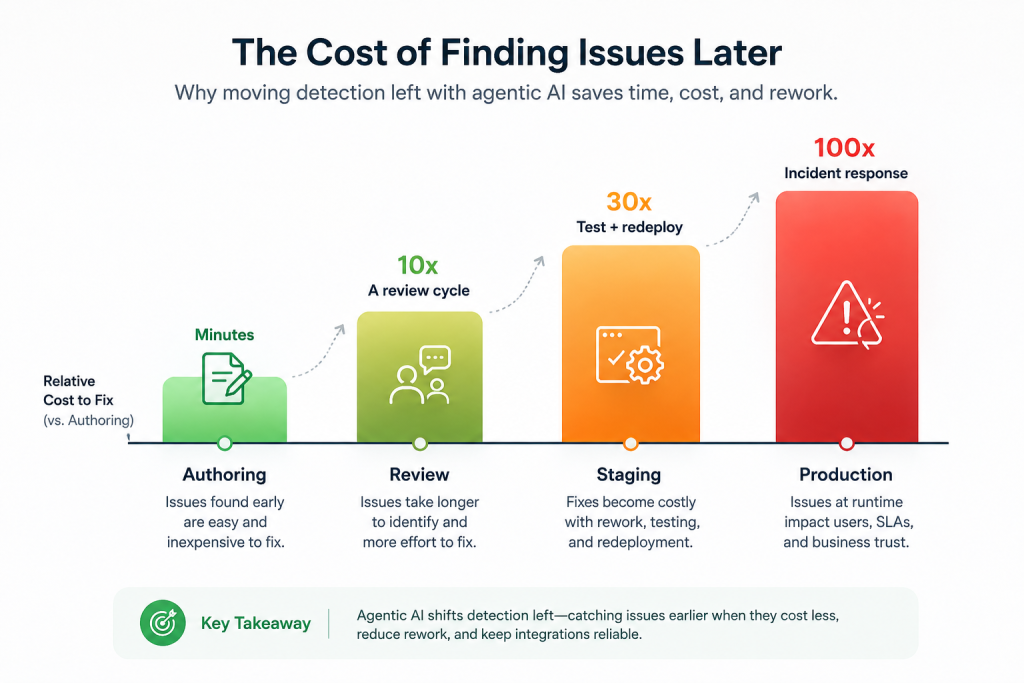
The same defect, four price tags
Rework doesn’t announce itself it accumulates. What changes the cost isn’t the defect. It’s the stage at which it’s found.
Ansible
Drift caught pre-PR
IBM MQ
Config checked pre-deploy
Sterling
Maps checked vs. spec
Detection stage
Author, not incident
Rework is expensive because it's invisible
Every integration team carries a tax it rarely tracks: rework. A misconfigured Ansible playbook passes review but fails in staging. An IBM MQ channel works in one environment and silently breaks in another. A Sterling map looks complete until a trading partner sends an EDI variant nobody tested for.
None of this shows up as one dramatic outage. It shows up as slower sprint velocity, a queue of “quick fixes” that never stay quick, repeated test cycles, and delayed releases. The tools are mature. The middleware is proven. Rework is not a technology problem it is a lifecycle problem.
This is where agentic AI changes the calculation, not as a feature bolted onto existing tools, but as a working layer inside the SDLC itself. PragmaEdge builds that layer through IBM BoB, a developer-facing agentic AI platform designed to operate inside the lifecycle, not beside it.
The organizations that get ahead of rework are not the ones with the most rigorous manual review. They are the ones that catch issues earliest, before they compound.
The same defect does not cost the same amount at every stage. Caught at authorship, it may take minutes. Caught in review, it costs a cycle. Caught in staging, it triggers retesting and redeployment. Caught in production, it becomes an incident with rollback and customer impact. Agentic AI’s value isn’t finding more issues it’s changing when issues are found.
Ansible — catching drift before it ships
Ansible playbooks are declarative, which makes them easy to write and easy to get subtly wrong: a variable that only works in one inventory, an unpinned dependency, a missing idempotency guard. An agentic layer reviews playbooks against the same patterns an experienced automation engineer would look for before the playbook becomes a pull request, not after it fails in staging.
IBM MQ validation before deployment
Configuration checked pre-deploy
Channel definitions, cluster configuration, SSL/TLS settings, and dead-letter queue handling all need to stay consistent as an MQ environment grows. Small inconsistencies often go unnoticed until a message fails to route. Agentic review checks configuration against organizational standards before deployment a consistent second set of eyes on the hundredth change of the week, not just the first.
Sterling reducing the EDI rework cycle
Maps checked against specification
Sterling B2B accuracy is a moving target: trading partners change schemas and implementation guides, and a map that was correct on delivery can break months later. Agentic AI adds an earlier validation layer between partner specifications and map logic, flagging schema drift before a transaction is rejected downstream.
IBM BoB: built into the developer's workflow
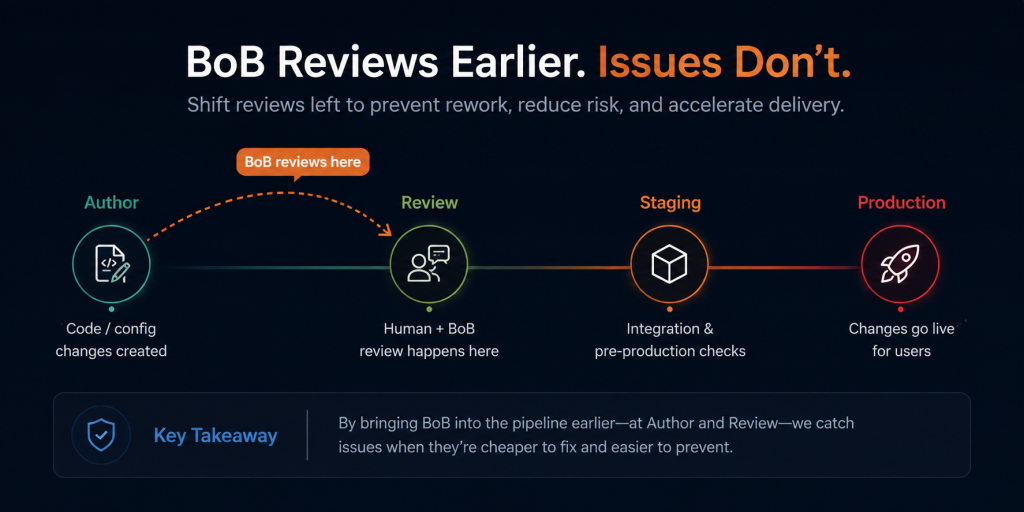
IBM BoB is a developer-facing agentic AI platform, not a runtime layered onto production. It reviews code and configuration as it’s written, surfacing risk before a commit becomes a pull request and before a pull request becomes a deployment.
Where the ROI shows up
The ROI from reducing rework is specific to each environment, but it consistently shows up in four places:
1
Developer time reclaimed
Capacity redirected from redoing work to new development.
2
Late-stage failures avoided
Fewer defects traveling the full investigation-to-incident path.
3
Review quality made consistent
The same standard applied to the first change and the hundredth.
4
Institutional knowledge, earlier
Expert judgment reaching developers at the point of work.
A practical way to measure it
The right question isn’t “what percentage improvement will AI give us.” It’s “how much rework are we paying for, and where is it being found.”
Step 1
Measure current state
Defects by stage · resolution effort
Reopened items · release delays
Step 2
Introduce agentic review
Issues caught pre-PR / pre-deploy
Recurring problem types
Step 3
Compare the movement
Fewer late-stage investigations
More issues caught while cheap
The business case isn't "AI replaces engineers"
It’s that AI helps engineering teams spend less time paying for work they’ve already done once. Ansible, IBM MQ, and Sterling environments carry years of accumulated configuration and business rules. The challenge isn’t generating more changes it’s making changes without creating the next cycle of rework.
Where PragmaEdge fits
PragmaEdge works with enterprises running Ansible, IBM MQ, and Sterling at scale. The pattern is consistent: the middleware is rarely the bottleneck the lifecycle around it is. As an IBM Gold Business Partner, PragmaEdge builds and deploys IBM BoB to close that gap: move detection earlier, reduce avoidable rework, and give engineering teams more capacity for work that creates new value.
See where rework is entering your SDLC