Enterprise AI adoption rarely happens through one team on one timeline. Business units build models and deploy agents at their own pace, with their own risk reviews and no shared view of what’s running elsewhere.
The result is familiar: disconnected inventories, duplicated reviews, audit prep that turns into a scramble, and uncertainty about where regulatory exposure sits. As adoption scales, fragmented oversight becomes the constraint on how much AI an enterprise can responsibly run.
What AI governance actually means
Governance is often reduced to “keep a model inventory” or “pass a compliance review.” Neither captures it. It’s the ongoing operating model an enterprise uses to answer, for every AI system it runs: what exists, who owns it, what it does, what risk it introduces, who can approve it, how it’s monitored, what happens when it changes, and how each decision gets evidenced. That follows a lifecycle, not a single checkpoint at launch.
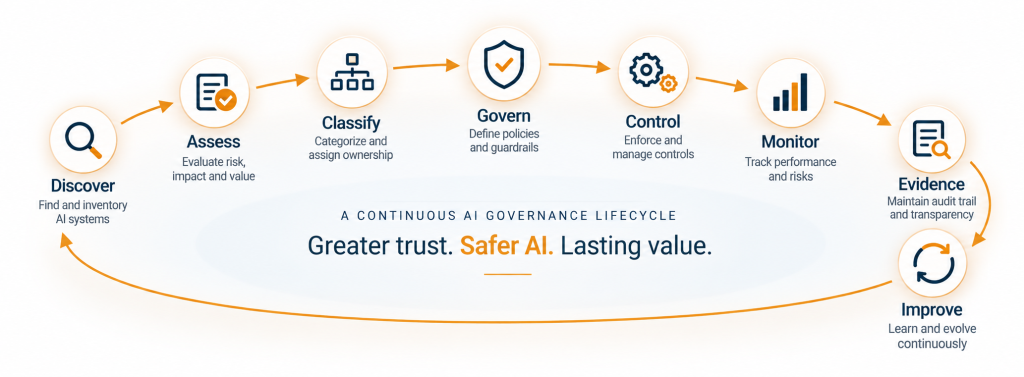
A system enters governance when it’s discovered, not when someone remembers to register it, and stays under governance for as long as it runs, not only at launch.
Governance is broader than compliance
Because regulation drives much of today’s urgency, it’s easy to treat governance as synonymous with compliance. That’s too narrow: compliance is one outcome of governance, not the whole of it. A complete model also covers accountability, ownership, operational and security risk, and human oversight. An enterprise can pass every audit and still have no clear answer for who’s accountable when a model behaves unexpectedly. That’s a governance gap, not a compliance one.
Governance has to be continuous
Enterprise AI doesn’t stay still. Models get retrained, configurations change, integrations get added, ownership moves between teams. An assessment performed once at deployment describes a system that may no longer exist a quarter later. Governance has to run continuously, not only at launch or the next scheduled audit.
Four capabilities, made operational
Enterprises rarely sit at one maturity level across their whole AI portfolio. This scale helps place different parts of it.
01
Fragmented
AI is discovered reactively; ownership is unclear; reviews happen independently by team.
02
Documented
Systems are inventoried; basic ownership and risk classification exist.
03
Governed
Policies, workflows, approvals, and controls are standardized across business units.
04
Continuously governed
Monitoring runs continuously and governance updates automatically as systems change.
05
Integrated
Governance is embedded directly into how AI gets built, deployed, and operated.
Where the gap usually sits at each level:
- Level 1-2:the gap is ownership itself. No one can say with confidence who’s accountable for a given system’s risk.
- Level 3:controls and approvals exist, but monitoring still runs on a fixed schedule, not continuously.
- Level 4:monitoring is continuous, but evidence is still assembled by hand once an audit or incident forces the question.
- Level 5:the residual gaps are usually edge cases: agents and new use cases that haven’t been folded into the same operating model yet.
What mature governance actually looks like
Level 5 is a useful destination, but it helps to be concrete about what changes in practice. A mature model has one system of record for every AI system and agent, kept current automatically rather than through manual updates; a risk classification method applied consistently across every business unit, not decided ad hoc by whichever team built the system; controls enforced technically, not only documented as policy, so a restriction actually stops an action rather than describing what shouldn’t happen; monitoring that feeds back into classification automatically, so a system’s risk status changes when its behavior does, without waiting for a scheduled review; and evidence that exists before anyone asks for it, generated as a byproduct of normal operation rather than assembled under audit deadline.
Governance needs an operating model, not just a tool
Technology enables governance; it doesn’t create it. A mature enterprise assigns clear ownership across business, product, engineering, data, security, legal, risk, compliance, AI/ML, and internal audit, so “who owns this system” has one answer everywhere. Without that model, even a well-designed platform becomes one more disconnected inventory.
What agentic AI adds
Most of the framework above is artifact-centric: assess a model once, classify it, monitor a fairly stable set of behaviors. Agents break that assumption. The same agent can behave differently session to session depending on the tools it’s given and the decisions it chains together, so governing an agent means governing behavior at runtime, not only the artifact that produced it.
That changes what each part of the framework covers. Inventory needs an identity and permission record for every agent and sub-agent, including which tools each can call. Control needs a defined scope: what a decision can trigger, and where a bad call’s blast radius gets contained by enforcement, not policy alone. Approval gates need to trigger mid-session, when an agent attempts something outside its scope, not only before deployment. Evidence needs an action-level trace, what was called, with what input, under whose authorization, alongside the model-level record. The lifecycle doesn’t change; control and evidence now have to run at the speed the agent runs.
Where a platform fits
An operating model still needs somewhere to run. PragmaEdge implements this approach using HOLAN, built on IBM watsonx.governance, configured to sit on top of the model, agent, and integration tooling already in place rather than replacing it. The platform supports the operating model above; it doesn’t substitute for one.
Governance vs. compliance?
Compliance means meeting a specific set of external rules. Governance also covers ownership, risk, security, and oversight no regulation directly requires.
How often should systems be reassessed?
Continuously, triggered by material change, not a fixed annual cycle.
Who should own AI governance?
No single team. Ownership spans business, risk, security, legal, and technical teams under one operating model.
Reactive alerting isn’t going away, and it shouldn’t it’s still the fastest way to know something has already broken. It was never built to answer the harder question: what’s about to break, and why.