For years, TIBCO has been the integration backbone behind some of the world’s most critical business processes. Orders move through it. Partners connect through it. Applications exchange data through it.
That’s precisely why moving away from TIBCO is rarely a simple technology swap. The question isn’t whether TIBCO can still run the business it can. It’s whether an increasingly legacy-centric integration estate is still the most sustainable economic and architectural choice, as enterprises adopt cloud, SaaS, APIs, and event streaming, and platform costs, specialized-skill dependence, and maintenance effort keep climbing.
The result is a familiar dilemma:
The longer you stay, the harder modernization can appear.
The faster you move, the greater the migration risk can become.
The answer doesn’t have to be either extreme. PragmaEdge takes a phased approach that reduces TIBCO dependency progressively – without betting the business on a single cutover.
The Real TIBCO TCO Is Bigger Than the License
Most organizations start with the software renewal. But the real cost runs far beyond licensing:
How this fits alongside systems you already trust
Platform & infrastructure
Specialized skills
Upgrades & patching
Testing & regression
There’s a harder cost to quantify: dependency. When integration knowledge sits with a few people who know TIBCO’s history, custom transformations, and production behavior, modernization becomes difficult — the platform grows expensive to maintain but risky to change.
The real question isn’t what TIBCO costs. It’s what it costs to keep operating, changing, and scaling the current estate.
Why Rip-and-Replace Creates Unnecessary Risk
A single BusinessWorks process can depend on dozens of applications, queues, databases, APIs, and partners – often undocumented:
Applications
EMS queues
Databases
APIs
External partners
Transformation logic
Scheduling & monitoring
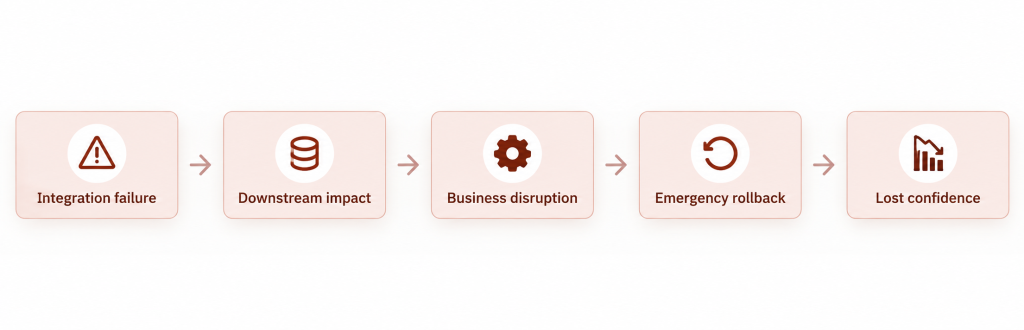
A “big bang” migration turns modernization into a business-continuity exercise one failure can cascade:
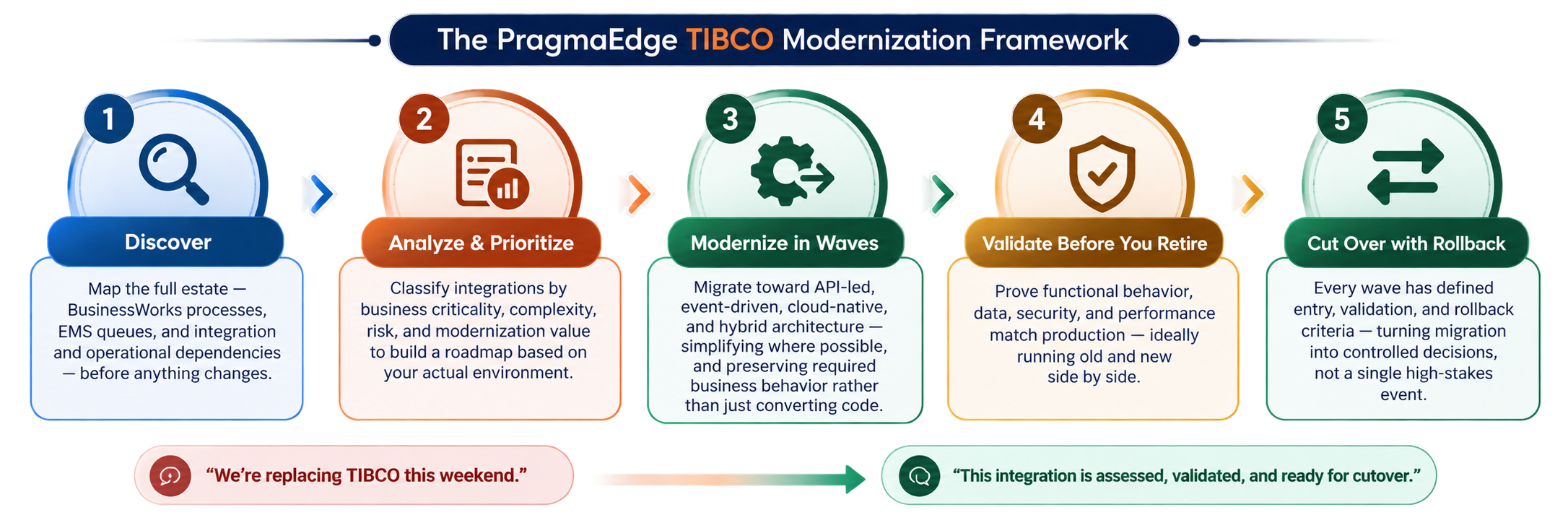
PragmaEdge breaks that chain with a controlled sequence — Discover, Assess, Prioritize, Modernize, Validate, Cut Over, Retire — so each wave creates a checkpoint before the next begins.
What Actually Changes for the Enterprise?
Success isn't measured by integrations migrated - it's measured by what becomes easier and less expensive afterward:
Lower Legacy Dependency
Less reliance on scarce TIBCO skills.
Lower Run-Cost Potential
Reduced platform and operational spend.
Faster Integration Delivery
Reusable, API- and event-based patterns.
Better Cloud & SaaS Alignment
Architecture built for today’s applications.
Improved Engineering Productivity
Capacity shifted to new capability, not upkeep.
Controlled Modernization
Incremental change, without full-estate risk.
The Destination Matters as Much as the Migration
Replacing TIBCO isn't modernization by itself. The target platform has to earn its place:
- Does it support the integration patterns you actually need?
- Does it reduce specialized-skill dependency, rather than move it?
- Does it align with your cloud and SaaS strategy?
- Can it scale economically as workloads and volumes grow?
- Can you govern it — security, observability, lifecycle — effectively?
The right destination is determined by your business, architecture, operating model, and economics — not a product name.
Where PragmaEdge Adds Value
PragmaEdge treats TIBCO modernization as an integration transformation program, not a technology conversion exercise, combining:
- Integration Discovery
- Migration Assessment
- Migration Automation
- Architecture Modernization
- Validation
- Phased Execution
- Legacy Retirement