
It is a management process of securing, scaling, publishing, designing, and cataloging your Application Programming Interfaces (APIs).API managementplatform enables you to create an ecosystem that helps you to manage the lifecycle of your APIs in order to add value to your business. The organizations use API management to create and control the application program interfaces in a secure way. This management process has some distinctive features like security, monitoring, and controlling, but its needs vary from organization to organization.
The need forAPI managementhas rapidly increased due to business dependence on it and the customers’ choice because they want to have direct contact with the enterprises also. The methodology and the process of managing APIs are entirely different from other programs and applications. To reap out the benefits properly, API management demands elaborate testing, high security and scrutiny, and routine versioning.
Importance of API Management
It makes the company’s valuable assets available through applications by exposing the data. By using APIs, any organization can add a digital layer to partner, employee, and customer interaction. Resultantly, it holds great importance because it allows organizations and developers to govern, scale, analyze, and monetize the APIs programs.
Another important aspect in managing the APIs is the scrutiny and security of APIs against cyber threats and attacks. Their protection demands more authenticating and authoritative user access. For the protection of sensitive data, strict policies must be designed. The platforms of API management also help the organizations to design a standard set of policy rules for the protection of APIs. Moreover, it helps to ensure traffic to the back-end system.
API governance is another important tenet of API management. This governance system helps to have a consistent experience for end-users. It ensures to developers that the program is built proficiently that adds value to businesses. Also, governance deals with the reusability of documentation and lifecycle management. Furthermore, the experience of mobile users can also be enhanced because, in great numbers, people use mobile phones in engaging with different applications. That is why there is a need for developers to use API governance in order to improve the mobile user experience.
The third important tenet of API management is centralization. The management process focuses on the collection and analysis of analytics. These analytics allow the organizations and developers to access and see the working of APIs and their performance. This centralization system is useful for organizations, teams, developers, and IT managers.
Lastly, it also monetizes APIs. The ability to generate revenues by any enterprise falls in the category of monetization of APIs. This important aspect includes the production of data, the building of customized plans, and the licensing of products.
Benefits of the API Management
API management web networking enables users to administer all features and aspects of any point platform in thecloud.
- API analytics has the ability to make data-driven decisions through business visions and insights.
- API management has centralized visibility that allows any organization to have a view of all their API networking. This centralization reduces security dilemmas and identification gaps for developers.
- It protects the organizations from security threats
- It has the ability to catch the attention of new customers via the production of API detailed documentation.
- API management system gives a reliable, cooperative, innovative, and flexible environment.
Functions of API Management Platform
Its management software is designed to make API design, maintenance, deployment more efficient. Though every management tool has its distinctive features, security, availability, and software testing are common. Apart from it, its software tools provide authority to the user to access the API, their logging details, transformation of data by an upstream service, accessing traffic and inspecting faultlines, creating the reports by monitoring API performance.
The Architecture of the API Management Platform
The architecture of theAPI management platformincorporates many interacting components such as reporting of analytics and usage; authorization management; community management; document live updating; API portal.
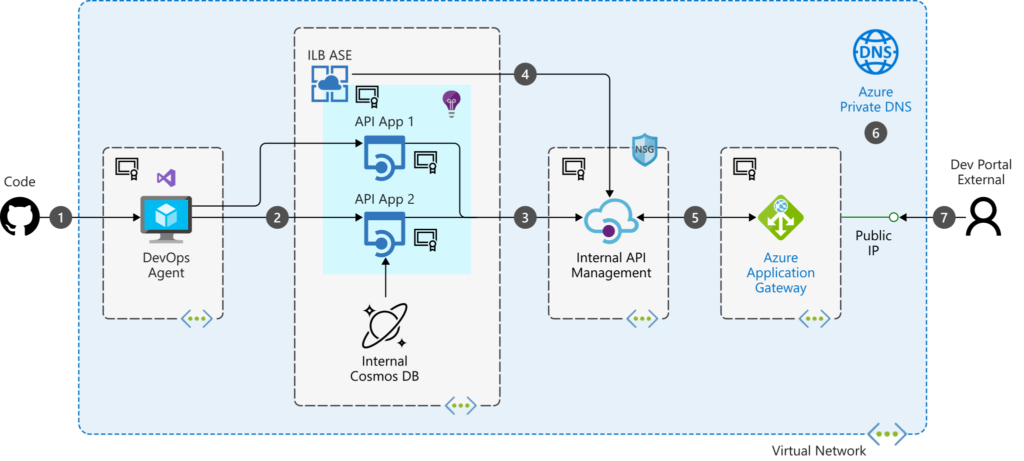
- The community manager is also known as the API portal which allows developers to deploy their APIs. To test and get access, internal and external developers use this portal.
- Generally, lifecycle management goes from designing to developing, then from development to testing, deployment, and retirement. This architectural feature allows organizations to manage the API journey at every level.
- After the management cycle, there comes the API policy manager. This policy manager feature handles the life cycles of policies. Many policies are like API. Many policies are entirely different that enhance performance, increase the security level, handle traffic, and upgrade the value. New policies can be applied without any written code.
- The users get various dashboards that can visualize various operational aspects via API analytics. These analytics are used to collect performance data or any error about patterns or usage.
- Another built-up feature is anAPI Gatewaythat allows the request of APIs to a user device. This gateway is also used as a management tool within microservices construction, and business-to-business integration. Also, as its name indicates, it is a middle passage between consumers and providers. If the API gateway functions in an impaired manner, failure of services could be the result. Moreover, serious security can arise if API gateway functionality is compromised. For this reason, organizers have to establish a strong mechanism of API gateway.
API Management Platform Examples
From small business enterprises tolarge business enterprisesAPI management platforms are available. These platforms are fulfilling the demands of various organizations to a great extent. Many multinational software organizations like Microsoft, Oracle, and many more have created their own API management services. Some examples of these management platforms are Sensedia, CA Technologies, Software AG, and Google Apigee API Management Platform.
Final Thoughts:
There is no denying the fact that customers want to have contact with companies or enterprises. This is done by a variety of mobile phones and other communication channels. For this reason, IT developers have been compelled to design more efficient development frameworks. Application Programming Interfaces (APIs) are the base upon which digital networking is established. It allows a business to securely expose the services and content. For this, the API management platform allows a business to take control over the APIs. This management platform is a solution that offers perks to the business world to add value to their business by using its software tools as mentioned above.